
📡 Does using AI make you look bad?
The uneasy relationship between AI, creativity, and credibility

Recently I’ve been hearing people say that using AI in professional deliveries is unethical, or embarrassing. The argument? AI-generated work carries a certain stigma. One that suggests laziness, dishonesty, or a lack of originality. But only when it looks like AI.
This thought doesn’t emerge in a vacuum. It’s shaped by corporate messaging, outdated industry norms, and a broader cultural discomfort with technological changes. It reminds me of the very first sentence in Sari Azout's article in The Sublime What matters in the age of AI is taste: 'The more I use AI, the more I realize ignoring its creative potential is like dismissing the ‘90s internet as a porn delivery system.'
There’s always a period of resistance before a tool’s real potential is fully understood. And the resistance to AI is part of a recurring pattern in how society adapts to new technologies.
One person that I worked with admitted they used AI to refine their writing, but they made a point of manually changing certain terms because they worried there were 'ChatGPT signature words' that could make them – and the work – look bad. Which, for me, highlights a strange paradox: AI can help improve our work, yet we feel the need to erase its traces to maintain our credibility.
Why? Let's overthink together.
AI’s reputation problem and the ‘Dead Internet’ theory
Read more → Forbes, The Verge, Insider, The National Law Review, Insider
Have you heard of the Dead Internet Theory? It’s the idea that much of the internet today is no longer made by human users but by AI-generated content. What started as a conspiracy has gained traction, as people feel that social platforms and search engines are filled with low-effort, bot-created sludge. Dani Di Placido’s article (Forbes) on the subject captures the essence of this digital unease: an internet that feels lifeless, overrun by automation, and not organic interaction.
The moment people suspect something is AI-generated, they tend to devalue it, regardless of its actual quality.
This trend didn’t start with AI. In my opinion, it began with SEO. In the race to rank higher on Google, content farms started churning out articles engineered for search engines rather than human readers. Slowly making the internet unreadable.
As Amanda Chicago Lewis pointed out in The Verge, SEO specialists became architects of today’s search-optimised wasteland, as some were once digital opportunists trying to game the system. The reality is more than that, though. Google’s own evolution prioritised SEO-driven content over genuine knowledge-sharing, reinforcing a system where algorithmic manipulation trumps organic discovery.
The backlash against AI content today mirrors the same frustrations people had with SEO-driven content years ago. The real issue? Not just AI, or the SEO specialists themselves, but the way profit-driven digital strategies warp the way we access and interpret information online. For example, in 2023, Google removed the word ‘people’ from its Search guidelines, signaling a shift where content that was AI-generated is no longer explicitly deprioritised.
The system created an environment where visibility trumped substance, priming the internet for what we now recognise as the enshitification effect. Now, AI is just accelerating a process that was already well underway.
The AI ‘Ick’ Factor: between ‘enshitification’ and democratisation
Read more → Digital Frontier, Nature, Eurekalert
There’s a corporate discomfort around AI, an ‘ick’ factor, especially when AI usage is overt. Words like ‘generated’, ‘automated’, or ‘powered by AI’ tend to raise eyebrows. Or better: the words ‘tapestry, leverage, resonate, dynamic, elevate, embark and, of course, delve’. In this Digital Frontier piece, Miles MacClure explored this AI vocabulary problem – the way certain phrases tip people off and cause them to disengage. It’s not just an aesthetic issue, more of an emotional reaction tied to deeper fears about authenticity and job security.
There's an interesting effect going on in language, as
‘the use of delve, crucial and significant (…) skyrocketed after the release of ChatGPT.
Researchers note that this vocabulary shift is a product of scientists using AI chatbots to aid in writing their papers, and it’s unclear if people are using these words more in everyday speech.’ - Miles MacClure
Studies highlighted in this other Digital Frontier article shows that people tend to rate AI-generated work significantly worse only after they are told it was AI-made. The aversion isn’t necessarily about quality, but about perception. We like to connect with other humans, and relate to the experiences that people write about – that often aren't unique.
AI, by contrast, feels alien, even when it produces comparable or better work.
For me, it's a tool. Like Photoshop for a designer, or a spellchecker for a writer, and its ethical use depends on how we engage with it. The real risk isn’t the technology itself, but letting it do our thinking for us.
The fear that AI will steal our jobs
Read more → The New York Times, Digital Frontier, Will robots take my job?
One major driver of the AI ‘ick’ is economic anxiety. People see AI as an existential threat to their careers, an inevitability they’d rather not acknowledge. And while automation has disrupted industries before (from factory work to customer service), AI's reach into creative and knowledge-based fields makes the fear feel more personal. If this is a fear of yours, get to ‘Will robots take my job?’ and search for your job title. I'm in the ‘moderate risk’ group.
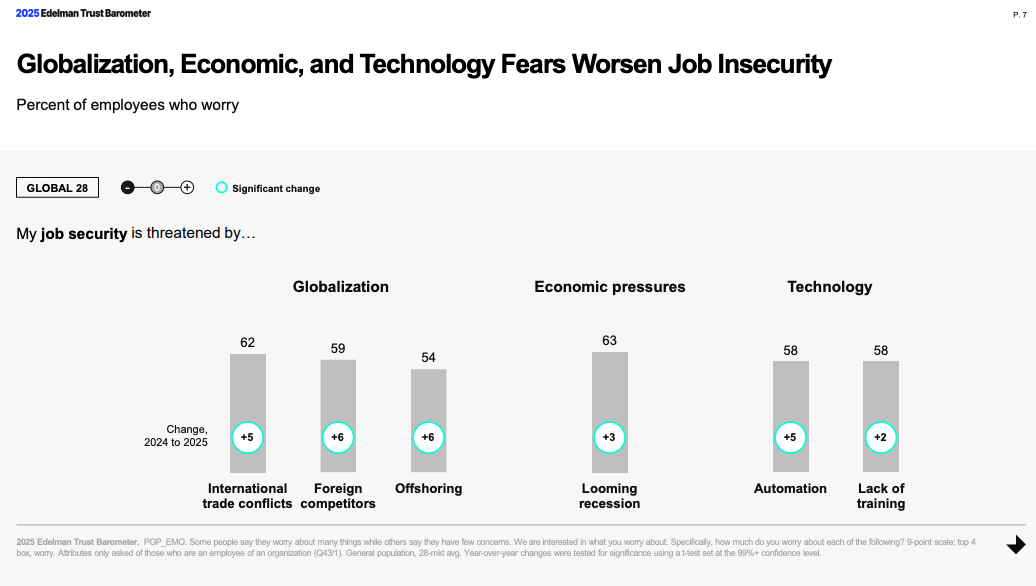
According to the 2025 Edelman Trust Barometer, 58% of employees now worry that automation threatens their job security, a 5% increase from last year. The same percentage also fear they lack the necessary training to keep up with technological changes, highlighting the anxiety over being left behind in an AI-driven workforce.
But there's another side to this: AI also lowers barriers. It can help those without access to elite institutions or expensive resources become creators, founders, or independent professionals. Whether it’s artists using it to refine their work, or small businesses using it for productivity, or (AI) film directors that don't have access to expensive equipment, the technology is more democratising than we often admit.
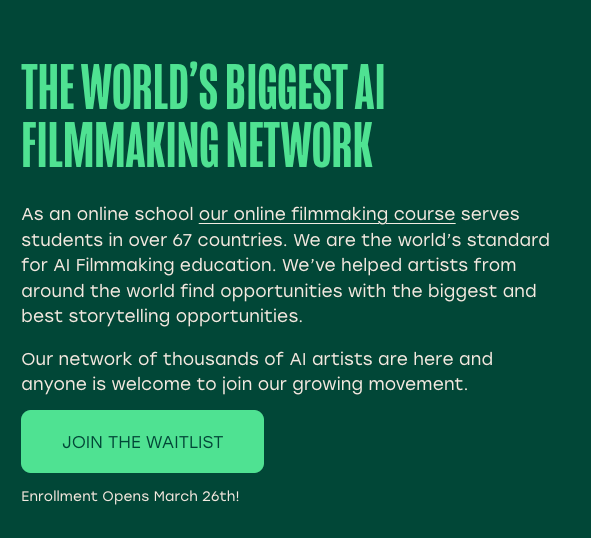
As Holly Herndon put it in conversation with Ezra Klein, she sees AI not as something purely artificial, but as a form of collective intelligence. An aggregation of human knowledge, creativity, and labour. By framing AI as something built on shared human contributions instead of a purely technological feat, she defends that we can develop a different relationship with the technology, one that acknowledges its origins in human expression rather than treating it as an alien force.
The problem here, for me, lies in how to give proper credit, as humans ‘have always been in collective projects, but we do give people a lot of individual ownership and authorship’. With AI, this becomes a huge challenge and I have more questions than answers.
The case for taste vs a flattened internet
Read more → The Honest Broker, The Sublime, Fio da meada, Pangram Labs, Pluralistic
Another one of the strongest arguments against AI is the so-called enshitification of the internet, a term popularised by Cory Doctorow to describe the decline of digital spaces into ad-filled, low-quality messes. AI content mills are churning out soulless, search-engine-optimised sludge. So, yes, platforms are flooded with AI-generated slop: over half of longer English-language posts on LinkedIn are made with AI, on Medium estimates are that over 40% of articles in 2024 may have been AI-generated, and over 1,200 news websites have been identified as operating with little to no human oversight, relying heavily on AI.
This reminds me of Ted Gioia’s ‘State of the Culture’ report description of how the internet has become 'flattened', stripped of its earlier diversity and spontaneity, and replaced by algorithmic uniformity. AI is often blamed for this, but Gioia points out that it’s a symptom of a larger trend: corporate standardisation.
‘All they really want is to impose standardization and predictability – because it’s more profitable.'
Following his thought, AI is just another lever that corporations are pulling to extract engagement while reducing costs.
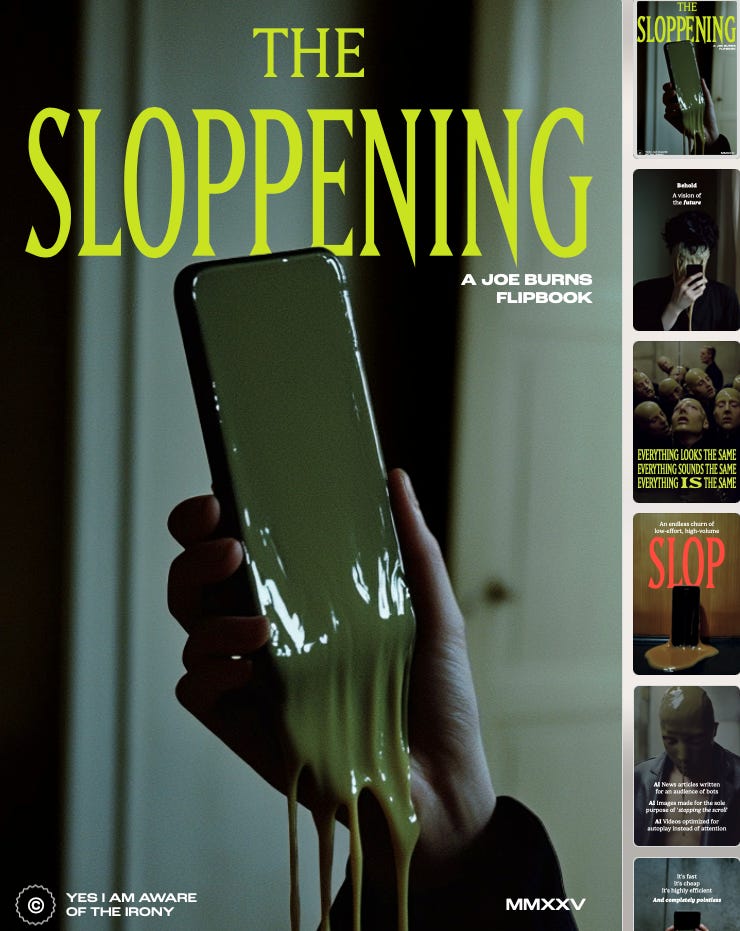
As Ana Talavera argues in her latest Fio da Meada News, despite all the talk of AI slop taking over the internet, there’s something tech still can’t generate: spontaneous virality, emotional impact, and true cultural resonance. Yes, we can have tools like Imgflip – an AI for creating memes – but no algorithm can replicate the psychodynamics of digital humour, the way certain jokes, phrases, or formats spread unpredictably through cultural nuance.
AI might replicate the form of creative expression, but it struggles to produce the feeling behind it.
This is where taste comes in.
Sari Azout (The Sublime) makes an important distinction: AI is powerful, but it’s taste-blind. It can generate infinite possibilities, but it doesn’t know what’s actually worth making. This is where curation, with human's ability to discern, refine, and build ideas, becomes more valuable than ever. As she puts it:
'The more AI can execute, the more your eye for what's interesting – your ability to discern and curate what matters and why – becomes everything.'
AI, at its best, is a collaborator instead of a replacement.
Like any tool, the impact of AI depends on how we use it. If used well, it can amplify creativity rather than dilute it. If we lean on it to replace original thinking or to deceive, then yes, that’s an issue. But using AI as a partner to enhance creativity, automate tedious tasks, or democratise access to technology? IMO, that’s just smart. And I'm very excited for the day we will have a humanoid robot at home to complete mundane household tasks.
One big question that sticks with me: Is this big discomfort with AI at work truly about ethics? Or is it a mix of the fear of appearing less competent, the unease of feeling disconnected from the work to the point where it no longer feels like our own, or simply a resistance to change?
An excellent read! Really well balanced and loved all the examples. Thanks for sharing.